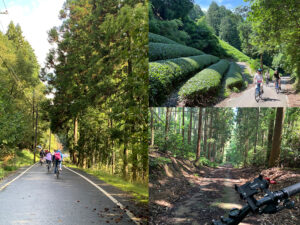
Just knowing the route will make cycling in Kyoto many times more enjoyable.
Kyoto is an ancient capital with a history of over 1,000 years, and there are many ancient roads that aristocrats and samurai traveled along. If you know the route, you can discover wonderful old roads just a short distance from the center of Kyoto. Kyoto is a compact city that is perfect for cycling, with urban and natural areas concentrated close to each other.
Kyoto is also a great base for long-distance cycling trips to the suburbs, making it the perfect cycling destination.
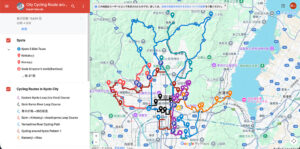

Cycling around Kyoto – Pilgrimage to hidden spots in Kyoto City –
In Kyoto City, there are no-bicycle zones around Shijo Kawaramachi, a bustling shopping street. Our self-guided system recommends hidden spots and relatively quiet routes in Kyoto, so it does not include the central Kyoto area (downtown district), where cycling is not comfortable.The digital map shows the routes used by local cyclists, including the Saga-Arashiyama area on the west side of Kyoto City (Tenryuji Temple, Monkey Park, Bamboo Forest Park, Adashino Nenbutsu Temple), Kinkaku-ji Temple, the Imperial Palace, and Daitoku-ji Temple in the center, the Higashiyama area on the east side (Kamo River, Gion, Nanzen-ji Temple), and Fushimi Inari Taisha Shrine on the south side.In Kyoto city, the tourist attractions can be roughly divided into two areas: Arashiyama (west) and Higashiyama (east). If you cycle around either area, the circumference is about 30km, but if you go via Fushimi Inari Taisha Shrine in the south, it is about 40km, and if you go via Kifune Shrine and Kurama Temple in the north, it is about 60km (a complete loop around Kyoto city).
Please be aware that police enforcement of bicycle regulations will become stricter from April 2026.

As the roads in Kyoto City have small steps and pebbles, we recommend an electric bicycle with a front suspension fork and block tires.Personally, I prefer E-MTBs or similar types of electric bicycles.You can rent this bike at our store

Kyoto to Lake Biwa – Japan’s National Cycle Roads –
It’s only about 20km from central Kyoto to Otsu City in Shiga Prefecture, where Lake Biwa is located. Lake Biwa is also recognized as a national cycle route and is famous throughout Japan. It’s the largest lake in Japan, with a 200km circumnavigation course.
It can be a bit dangerous to head to Lake Biwa via the busy national highway between Kyoto and Otsu. Our original Google My Maps guides you to safe, hidden routes with beautiful scenery that only local cyclists know about.
Cycling from Kyoto to Lake Biwa(Jump to the headquarters website)

Lake Biwa is a national cycle road, so the roads are well maintained in many places. The roads are marked with blue lines for bicycles, and are flat, making it easy to go fast. Many cyclists ride non-electric road bikes, but if you have an electric bike, we recommend a touring type.You can rent this bike at our store
Kyoto to Miyama – Satoyama, a symbol of the rural Japan –
It is approximately 70km from Kyoto City to Miyama Town. If you are cycling, there are two main routes. The most famous route is from Kyomi Pass north of Kinkaku-ji Temple, along Shuzan Kaido, to Keihoku Town and then to Miyama Town.
The other route is via Rokucho Pass in Oku-Arashiyama, heading to Yuzu no Sato, Hiyoshi Dam and then Miyama Town. You can choose a course based on your cycling level.

Kyoto to Nara – Two ancient capitals and the tea fields of Wazuka –
Kyoto and Nara are ancient capitals with a history of over 1,000 years. Modern, well-maintained national highways have heavy traffic and are not suitable for cycling. Therefore, we recommend the ancient roads that the samurai used. There is little traffic and you can cycle while viewing the old townscape. Wazuka Town, located halfway between Kyoto and Nara, is a particular highlight. Wazuka Town is a major producer of Japanese tea (matcha), and this route allows you to cycle along the roads of vast tea plantations.
The shortest route from Kyoto City to Nara Park, where there are many deer, is about 45km, but the main road is too busy and dangerous. We recommend the approximately 70km route, which has less traffic and passes through the ancient Japanese tea plantations in Wazuka Town.

Kyoto to Tango Peninsula – The origin of Japan –
Japan has many wonderful cycling routes, including the Shimanami Kaido, Lake Biwa, and Hida Takayama, but personally, the Tango Peninsula on the coast of Kyoto Prefecture is exceptional. The terrain and scenery change dramatically, making it an exciting field for true cyclists. It is also a region with a long history as the birthplace of Japan, where you can discover the good old days of Japan. Our shop, headquartered on the Tango Peninsula, is familiar with the local cycling routes and even has its own original Google My Maps.
The shortest route from Kyoto City to the Tango Peninsula is about 120km, but it includes dangerous sections with heavy traffic, so we recommend taking the back roads used by local cyclists, which offer beautiful scenery and safety. Depending on the route, if you stop at accommodations, the total distance is about 160km. If you include a route that circles the Tango Peninsula, the total distance is over 200km.
Self-guided and fully guided tour details

We recommend an E-MTB or touring electric bicycle, as the route involves cycling over varied terrain with many ups and downs. Although the route is paved, you will often ride on mountain roads and encounter small twigs and pebbles on the road. For safe cycling, we recommend an E-MTB.You can rent this bike at our store


The handlebars are already equipped with a mobile phone holder and a water bottle holder.

We have helmets available in a variety of sizes, including children’s helmets, and we also provide anti-theft locks. All of these can be borrowed free of charge.

Battery chargers are available for rental to customers who rent for two days or more, and pannier bags are available for rental to customers who have a lot of luggage or who are going on long-distance bicycle trips.
*There are some vehicle models that cannot be fitted with pannier bags.

We have both original Google maps and paper maps available for self-guided use. If you tell our staff what you need when you visit our store, they may be able to give you some good advice.

Inquiry
Please contact via Chat App by pressing the button below.
If you cannnot use all of these application, please contact
kyoto.ocean@gmail.com


All informations